July 31, 2026

When Medical Doctors (MDs) become Snake Oil Salesmen, the Public will Suffer


Canadians are lucky in that they have universal health insurance, which simply means that everyone living in a Province is in the insurance plan. Canadian male and female life expectancy is also well over 80 years old while Americans on average have life expectancies lower than 80 years old. 

CBC Market Place has an interesting article this week on how some Canadian doctors are using a loop hole to practice medicine without evidence (that is not evidence based medicine) to get themselves richer by prescribing peptides to patients who generally grow up trusting the medical profession. 

I predict this will over time slowly erode the trust Canadians have for MDs, which will be unfortunate. 

Read about the Peptide Snake Oil here. At CBC. 


KPM

April 24, 2026

Nothing Comes Free: Wegovy and Ozempic can damage your vision

 Nothing comes free.

This new class of diet drugs have generated adverse reports of ischemic optic neuropathy. Exercise and eating healthier foods is my recommendation for your longer term health. Read my summary for more information.

April 11, 2026

Let's Dance with the Moon: follow the Artemis II mission with Flight Day updates.


April 11, 2026 update

In 1969 as a young boy, I was lucky to have watched, along with the entire world, Apollo 11 launch and land on the Moon and return safely to the Earth. A mission started by the leadership of President John F. Kennedy. Now my children will, in a few more years, also see humans land and walk on the Moon. April 1 was the first launch window, of about 2 hours in duration, for a chance to launch Artemis-II into Earth orbit with four NASA astronauts, three Americans and one Canadian. Mother Nature cooperated, and so did the rocket, launching at 6:35 PM EST.

The Orion spacecraft has just over 355,000 parts, built by NASA and prime contractor Lockheed Martin. The spacecraft injected itself into a flight into deep space on April 2, headed around the moon to return to Earth. We all watched for 10 earth-flight days the successful test of the space craft as four of human kind travelled farther from Earth than anyone in human history. Over 3/4 of all persons on Earth were born after Apollo 17, the last time human walked on the Moon. I am one of the 1/4 persons who were born before Apollo and got to see all of the Apollo astronauts walk on the Moon.

Crew assembling seating and stowing cargo, preparation for reentry on Flight Day 10

LINK TO: 

NASA Video Event: Artemis Crew Returns to Houston 4PM EST (Saturday 4/11/2026)


As you now know, the Artemis II mission was a great success, and maybe you also watched live, the reentry and splashdown on Friday evening, April 10, 2026. If you want to compare to Apollo 11, you can visit my post on Apollo 11, The Lockdown Edition. 

Here are the window view stills that I captured in the last couple of minutes as the reentry interface period began. Note that the last image in the sequence shows the starting plasma glow from heating of the spacecraft's heat shield as the Orion space capsule entered significant atmosphere around 400,000 ft of altitude, up to 26, 000 miles per hour.

Crew view about 3 1/2 minutes before atmospheric heating plasma began communications blackout.


Plasma glow of reenetry visible here just before communications blackout.

 The Introduction section has information about the vehicle and the mission. The Flight Day (FD) Activity Updates section has information that I posted during each day during the mission activities and progress.

Introduction

Orion spacecraft. The European service module, the crew module, and the launch abort system (LAS).

The Orion space system comprises the European service module, the crew module, and the launch abort system (LAS). This system made its first mission without crew during Artemis-I and travelled farther from Earth than any previous crew-carry system. 

The full SLS, Space Launch System, from the United Launch Alliance (ULA) is summarized in this infographic from the NASA Artemis II Reference Guide. ULA was formed by a 50/50 joint venture (December 2006) between Boeing and Lockheed Martin to combine their respective U.S. government launch operations, including the Atlas V rocket and the SLS. You can watch the BEST tour of the ULA rocket factory here at the Smarter Every Day youtube channel. A good hour and I recommmend it highly.

Artemis II summary infographic (Click to enlarge)

Artemis 2 will take humans farther away from Earth than any previous time. A Canadian crew member will make Canada the second nation on Earth to send a citizen beyond Earth orbit, and also the second national to go beyond the Moon. The four astronauts selected for NASA’s Artemis-II mission: Commander Reid Wiseman, pilot Victor Glover, mission specialist Christina Koch from NASA, and mission specialist Jeremy Hansen from the Canadian Space Agency. You can learn more about the crew themselves here from NASA video: (Opens in a new window.)

Artemis II crew member face profiles in helmets.

 I hope that Dr. Schmitt, from Apollo 17, is still around to one day talk to the next humans to walk on the Moon in the next few years. You can see an interview with him here: Dr. Harrison Schmitt, Apollo 17 astronaut.  Before leaving the moon in 1972, Eugene Cernan etched his daughter’s initials, "TDC" (Tracy Dawn Cernan), into the dust. With no wind or atmosphere to disturb the surface, the initials will likely remain there for thousands of years.

1) Launch and information leading up the launch here at NASA's website feed for Artemis II:  Visit NASA's video feed here. (Opens in a new window.) You can also watch the same feed on YouTube HERE

2) View the location of Orion using Artemis Real-Time Orbit (AROW). 

3) NASA Mission Control Live Broadcast: YouTube Mission Control Live (in new window)

4) There are lots of acronyms in use throughout NASA and you can find many of them explained here: NASA Science Acronyms (link opens in new window).


Current Status: April 10, 3:18 pm EST, under 40,000 miles from Earth
AROW tracking of Artemis inbound to Earth.

Flight Day (FD) Activity Updates

Mission was a success. Reentry was spot on, Friday evening April 10th. Over a billion humans watched the event all around Earth.


Four crew, in red suits left, seated on the "front porch" raft after exiting the Orion capsule. (Still captured from NASA live video mission feed.)

April 10 (Friday): FD10 Return to Earth Day!

Welcome to flight day 10. The crew is preparing to enter Earth orbit and for reentry and splash down, occurring this evening. Planned reentry interface was at Mission Elapsed Time (MET) of 09/01:30 and will last 13 minutes, quickly to splash down. ZERO MET today is 6:35 pm (the time when mission launched on April 1. 

Latest adjustment indicates that reentry may start at 7:53 pm  Eastern Time (6:53 pm Central, 5:53 pm Mountain, 4:53 pm Pacific). 

Crew setting up seating and displays and cargo away for reentry and splash down.

Entry descent, landing: from NASA's mission blog.


Flight Day 10 plan. Click to enlarge.

Reentry interface starts at 400,000 ft altitude, just south east of the Hawaiian Islands, and will quickly continue to splash down after only 13 minutes, off the coast of San Diego CA. 


April 9 (Thursday): FD09 inbound closer to Earth

Welcome to flight day 9, the penultimate flight  day back to Earth. Tomorrow will be insertion into Earth orbital capture and reentry phase to spashdown, planned just off the coast of Southern California in the Pacific Ocean.

The activity planning map for today is shown below.
The NASA schedule for Flight Day 9 is shown below
Flight Day 09 plan. Click to enlarge.

Looks like the working day will start off with some preparation and study of Earth reentry process and procedures and then some reentry preparation begins in the spacescraft towards getting configured for return to Earth. This evening after mealtime, there is a scheduled Public Affairs Office event. Also today is dress up time, the OIG DON blocks seen in the schedule. These stand for (wait for it).... "Orthostatic Intolerance Garment Donning". This is a garment that will help keep blood in astronaut's heads after their body has been in zero gravity for 10 days. These garments basically are like g-suits and squeeze the legs and abdomen to prevent blood from pooling too much in the lower body. Orthostatic Intolerance is the condition of getting light-headed because blood content has tended to transfer to the lower body in zero gravity. A little g-force during reentry would make you pass out. 

April 9, 10:55 AM EST. 
Trans-Earth, 148,550 miles from Earth, 128,849 miles from the Moon

3:12 PM EST, 137,823 miles from Earth, 137,882 miles 
from the Moon

April 8 (Wednesday): FD08 mid inbound to Earth (Trans Earth)

Flight Day 8, and the crew will have more full work day today doing more testing of the Orion space flight operations. 

In addition to crew exercise and medical monitoring for science evaluation, there will be a practice testing the set up of the radiation shelter demonstration. This is a process to fill bags with water that are are set up in storage cabinet walls to create a radiation adsorbing and blocking shelter. This would be needed if a Solar activity increase would send extra Solar radiation into local space. Solar and galactic radiation is substantial and includes gamma radiation and positron radiation and neutron radiation. 

Protons and high energy charged nuclei (HZE), based on iron (Fe) and silicone (Si), penetrate the hull materials of the spacecraft and they then traverse all tissues of the human body, including the Central Nervous System (CNS). They easily breach aluminum as they travel almost at the speed of light. 

Molecular consequences include double-strand DNA breaks, free radical generation and oxidation stress. These mechanisms can work in synergy to harm CNS functions in the short term and to increase risk of cancer in the long term. Earth's magnetic field and our charged atmosphere shields us from much of this Solar and galactic radiation, and even protects lower Earth orbit astronauts. In high Earth orbit, trans-lunar, lunar orbit and trans-Earth flight, a spacecraft no longer has that protection. So the crew will practice assembly of the radiation shelter while they are in zero gravity.

The NASA schedule for Flight Day 8 is shown below: (Click to see larger)


Location on April 8, 1 PM EST. 197,687 miles from Earth, 86,310 miles from Moon

You can read more here from the NASA Mission Blog for flight day 8 

April 7 (Tuesday): FD07 early inbound to Earth (Trans Earth)

The crew will have more rest and recreation time today after their very busy last two days to prepare and to carry out the lunar observation tasks. There will be some medical data collection and a post lunar-observation debriefing meeting with mission control. A session of astronaut exercise will occur as well as main meal and some completely off duty time. 

RTC1 is a potential first burn for a Return Trajectory Correction. This is currently the Trans Earth phase of the mission, on the way home.

The NASA schedule for Flight Day 7 is shown below: (Click to see larger)

April 7 @ 8:34AM (EST) 30,129 miles from Moon, 239, 627 miles from Earth

Location from NASA AROW site. Click to enlarge.

NASA Artemis Daily News for April 7


April 6 (Monday): FD06  Lunar Observation DAY!

At 7:07 PM EST today, the Artemis II crew will be farther from Earth than any human before, extending Apollo 13 crew record by another few thousand miles. 

The NASA schedule for Flight Day 6 is shown below: (Click to see larger)

These are the planned events in Eastern Time (North America)

from Abby Graf's offical Artemis activity blog at NASA's website.

12:41 a.m.: Orion enters lunar sphere of influence at 41,072 miles from the Moon.

1:30 p.m.: The science officer in mission control will brief the crew on their science goals for the upcoming flyby. 

1:56 p.m.: The Artemis II crew is expected surpass the record previously set by the Apollo 13 crew in 1970 for the farthest humans have ever traveled from Earth. 

2:45 p.m.: Lunar observations begin. 

6:44 p.m.: Mission control expects to temporarily lose communication with the crew as the Orion spacecraft passes behind the Moon. 

6:45 p.m.: During “Earthset,” Earth will glide behind the Moon from Orion’s perspective.

7:02 p.m.: Orion reaches its closest approach to the Moon at 4,070 miles above the surface.

7:07 p.m.: Crew reach their maximum distance from Earth during the mission.

7:25 p.m.: “Earthrise” marks Earth coming back into view on the opposite edge of the Moon. 

7:25 p.m.: NASA’s Mission Control Center should re -acquire communication with the astronauts.  

8:35-9:32 p.m.: During a solar eclipse, the Sun will pass behind the Moon from the crew’s perspective.

9:20 p.m.: Lunar observations conclude. 

Tuesday, April 7

1:25 p.m.: Orion exits the lunar sphere of influence at 41,072 miles from the Moon.


Location on Monday April 6, Flight Day 06, outbound about 15,000 miles from the Moon @12:35 PM EST


Monday April 6, Flight Day 06, lunar observation period about 7,000 miles from the Moon @4:30 PM EST. Note the trajectory location view (left) explains the solar-array camera view from Orion (right).


April 5 (Sunday): FD05 (Outbound, nearer now to the Moon.)

NASA Mission Control Live Broadcast: YouTube Mission Control Live (in new window)

The NASA schedule for Flight Day 5 is shown below: (Click to see larger)

There is another scheduled Outbound-Trajectory Correction thrust adjustment scheduled to be used if required today (OTC3). Today Demonstration Flight Test Objective (DFTO) testing will involved testing of space suits (OCSS). Space suits are put on in zero gravity, for practice, and they will have to do this on the last day of the mission before reentry. Previously they have put the suits on for launch in normal gravity. They will also test ports on the suits that allow them to get medications and food (energy shakes) with the suit on. If there was a failure of life support on the space craft, then the crew could wear the suits all the way home.

NASA Artemis Daily News for April 5

Note: at 12:40 AM EST (Monday Morning) the spacecraft will enter the Moon's sphere of influence, meaning that it is more affected by the Moon's gravity than the Earth's gravity. 

FD05, April 5, 2:30 PM EST. 60,000 miles from Moon.

Monday, upcoming FD06 is the close lunar fly-by.

The Day 5, April 5th NASA Artemis II Daily News Conference

Check out Abby Graf's blog post for Flight Day 5 from NASA


April 4 (Saturday): FD04 (Outbound, over halfway to the Moon.)

NASA Mission Control Live Broadcast: YouTube Mission Control Live (in new window)

The NASA schedule for Flight Day 4 is shown below: (Click to see larger)

As of 11:20 am EST, the Orion spacecraft is over 166,000 miles from Earth and 113,000 miles from the Moon. Speed 2,435 M/H (relative to Earth). If required there is another Outbound Trajectory Correction burn (OCT2) in the schedule. Some ready review and training for lunar camera observation seems to be listed in the days events for astronauts. Check in with the YouTube Mission Control Live link. Several hours of feed are available so you can usually zip back and forth in the feed from current live to any activity in the last several hours on the mission control channel. 
Some Demonstration Flight Test Objective (DFTO) testing is on for today. That will be full testing of all the piloting functions of the Orion spacecraft by pilot (Victor). 3 and 6 degrees of angle including traslational up down, side to side, control around all three axis (longitudinal, lateral, normal). 

Location @11:20 am EST, April 4 (FD04)

Note the duration is 2 days 16 hours, but this is calendar flight day 04 since launch.
kpm

April 3 (Friday): FD03 (On the way to the Moon.)

NASA Mission Control Live Broadcast: YouTube Mission Control Live (in new window)

The NASA schedule for Flight Day 3 is shown below: (Click to see larger)


Today the mission is on the way to the Moon after yesterday's Trans-Lunar Injection engine burn of 5 minutes and 50 seconds. This happened as the spacecraft was moving fast on a close orbital pass of Earth, accelerated by Earth's gravity. Additional speed from the the engine burn caused escape from orbit. This evening (EST) will be the first of potential Outbound Trajectory Correction thrust adjustments (OTC1, Blue) to fine tune the speed of Orion to keep on the optimal desired track. 
This correction is for activity on Orion that can alter its overall speed. Venting of any gasses, or even waste dumps all change the speed in very small amounts but over 250,000 miles can have a large impact on orbital track. A second OCT2 adjustment will happen before reaching the Moon. The MET time scale show hours in 24 hour segments that started at launch, which you recall was 6:35 PM. 

From Public Affairs Office today: the deviation was so small that the OTC1 was a no-burn required burn. So performance and tracking and trajectory control have been very accurate.
The Moon is currently heading to the small blue loop where Orion will be captured by it's gravity. You can imagine that the calculations must be very accurate, and none of this would be possible without the field of mathematics. Orion and the Moon are two space objects that are both very far away from where they will dance. View from the Artemis Real-Time Orbit Website (AROW). 


Location at 11:20 AM EST April 3, FD03. Earth and Sun behind Orion.

Here is a view from one of the cameras on a solar panel today, viewing the back of the European service module and the main engine nozzle and smaller thruster nozzles.
Artemis II mission aft section, view from an extended solar panel. NASA live feed April 3.

The Orion will be in Lunar observation mode later on in Flight Day 6. Orion will arc around the far side of the Moon and will get as close as about 4,000 miles to the spacecraft. The TLI burn yesterday was the last major main engine burn required for the entire trip as the spacecraft is slowly losing speed until it gets closer to the effect of the Moon's gravity. Then it will accelerate again as it slings around the moon but does not enter Moon orbit, headed back to capture by Earth's gravity. This is FD03 of 10 total flight days. At 10:30 AM EST, the craft is moving at 4,185 M/H, is 90,774 Miles from Earth and 168, 016 miles from the Moon. The crew members are humans who have now traveled farther from Earth than all other astronauts except for those (21) who flew on Apollo 11, 12, 13, 14, 15, 16, 17.  The many more humans who have flown on space station, shuttle, and other current missions have all remained in low earth orbit. 
Flight Day 03. Solar panel cam view of adjacent solar panel and the NASA logo side of Orion, aft.

April 2 (Thursday): FD02

Welcome to flight day 1 to day 2 transition. Later today will start the Trans-Lunar part of the mission after astronauts complete testing underway while in high earth orbit. That will be at 25 hours since launch. FD02 MET +1, or 7:35 PM EST. 

NASA Mission Control Live Broadcast: YouTube Mission Control Live (in new window)

The NASA schedule for flight day 2 is shown below:

Since FD01, astronauts have had a couple of rest sleep periods in the schedule. You can also note times for meal breaks with all the other tasks in play. There is exercise testing earlier on April 2nd, and about 25 hours after launch, the Artemis 2 will do the TLI burn (Blue) Trans-Lunar Injection to head on their way around the Moon. Light blue blocks in the timeline are points of engine burns to control and change orbits and trajectories. Click on the schedule to load it larger for viewing. Testing continues throughout the mission on all the functions of the space craft. This includes its maneuvering systems and components and bracket adaptors that are to be used in the future for docking procedures. Remember that once the program gets to including a lunar module, that spacecraft will have to be docked by the command module pilot to capture in orbit at the moon. The Orion space craft takes the astronauts to Lunar orbit, where they will meet up with the landing system, which is being designed and built by Space-X. The service module and the capsule also have unfolded solar panels that track the Sun and provide solar charging of batteries which means that all electricity does not have to be derived from hydrogen fuel cells, giving this craft more usable fuel. This is a major difference from Apollo, where a lunar module was captured in Earth orbit and then brought to the Moon. 

April 1 (Wednesday): FD01 (Flight Day 01)

There was no substantial delay today (April 1, Wednesday). There were about 6 more days  available for launch. The window on any day is only about 2 hours due to the desire to have the Moon in a specific location relative to the Florida side of Earth, location of Cape Canaveral and the Kennedy Space Center.

The graphical plan for flight day 1 is laid out in this selection of FD01 provided by NASA:

Times above the schedule (MET) are starting at launch time which was 6:35 PM EST (US/Canada). PAO blocks are Public Affairs Office events, typically NASA audio/video broadcasts about the mission. Light blue blocks are engine burn events to control the spacecraft. Note there are sleep times and other events. You will see that meal time is scheduled once each flight day. Click on the schedule to see it larger for easy reading.


April 3, 2026

APOLLO 11 TRACKER: the Pandemic Lockdown Edition for NASA Lovers like me.

Come with me in 2019, and follow in real-time (50 years ago) what is/was going on with the Apollo 11 Mission to the Moon. You can get these reference books today if you are a NASA fan like me. I also have my Buzz Aldrin NASA Ball Cap on. These books were news reference books published by NASA. They were in the hands of Walter Cronkite and his coworkers and they are great for nerds like me. 

Updated April 3, 2026, my Apollo 11 blog in real-time, first posted in July 2019 recapturing the mission of Apollo 11 on it's 50th anniversary. I also reposted this for anyone stuck at home during our COVID19 pandemic stay-at-home activities (2020) for its 51st anniversary. I am old enough to have watched Apollo missions on TV, CBS News, with Walter Cronkite the voice who guided us through each mission live. It is quite true that scientists and engineers of my age were young children who discovered our love of science and technology from the NASA Apollo program, and some of us from Mr. Spock on Star Trek (original series). All on a black and white TV and newspaper clippings from the Toronto Star, NYTimes and Washington Post. Now my children in 2026 will soon see humans reach the Moon and walk on the Moon once again. My tracking post on the Artemis-II mission of April 2026 is here in The Science Rant: Artemis-II if you would like to compare Apollo to Artemis. 

November 1, 2025

Evidence Based Medicine is Less than 50 years old: born in Hamilton Ontario from an American doctor who made Canada home.

This is a slight update of my posting from 2019, inspired by the fact that the current federal administration of my country is throwing out Evidence Based Medicine as applied to protecting the health of persons in the United States. This is serious enough that six former Surgeons General of the United States have published an editorial in the Washington Post warning Americans of the danger this poses to their future health. (See Six Surgeons General: It's our duty to warn the nation about JFK Jr., October 7, 2025). How long have we been using Evidence Based Medicine (EBM)? Not as long as you may think, but we benefit from EBM, a concept that was helped along by an important American physician and educator, David Sackett MD.

September 4, 2025

mRNA Vaccines: what the 1st Trump administration did correct and is now putting in jeopardy in 2025.

Updated 9-4-2025 

As a biochemistry professional, I have followed the science of COVID-19 before most people had heard about it, before it was reported outside of China. Along the way from the pandemic start, through vaccine development, the overwhelming of hospitals, and the arrival of the first COVID-19 vaccines, I have read and listened to politicians and some scientists argue that natural immunity would be good enough. The idea is that you should just let the disease spread and natural immunity will build up. Well, yes that is true, if you survive a viral infection you will most likely have some immunity for some time. The problem with their suggestion however is the survival part and the cost of herd natural immunity. That cost is permanent damage and increased personal risk of future death from MACE. Fortunately, the first Trump administration decided to go with the strategy of "Warp Speed" to get vaccines developed faster than at any time in history. Read on for some explanation about this and learn how MACE can kill you.

Walking the DOGE? They may leave a mess for you: a government purse with no watchdogs and lack of medical research.

Back in February I wrote this post and have updated it today as we start the Fall term and I just taught the first class of Science of Vision to a collection of our young future bioscience colleagues. Both undergraduate and graduate students. In February, you were told that government workers are criminals and frauds, and that biomedical scientists like me are ripping us off. Despite that rhetoric, after 6 months there has not been any evidence presented at all to show where the fraud is or what the fraud is. Why? Because its really hard to cheat with government funds without getting caught and stopped. At least it used to be before all the Inspector Generals of the US Government were closed down. Now the US House is considering slashing the NIH budget by 40%. As I am a scientist, I am writing this to tell you all about the science of how federal research grants work in the United States, and why activities like potential new medical treatment development will simply stop if we chop away the indirect cost components of grants and slash the NIH budget. Here explained with examples:

September 25, 2024

Human Guinea Pigs, the people paid to safety test potential new drugs are not really volunteers without pressure.

The first testing of a drug to be approved in Canada, or in the US by the FDA, or for the EU's drug agency, requires giving the drug at various doses to healthy persons. We often are taught that these are very much volunteers, who participate for only good reasons. 

If there are bad side effects or even dangerous consequences to new drugs, then these factors must be known or clinical trials on sick persons might cause great harm. Yet, we seem to experience the removal of some drugs from the market long after their approved use causes some severe adverse effects. The adverse effects signal tends to take a couple of years or more before it becomes apparent that the drug should never have been approved because of its severe side effects. How can this be missed in Phase-I? This is how.

April 10, 2024

Solar Eclipse Safely, from a Vision Scientist.

 Now we are post-eclipse. If you or anyone you know is noticing a new difficulty reading with their central vision today (Wednesday, two days after the eclipse), and they spent some time watching the solar eclipse without solar safety glasses, then it's time to visit an optometrist or ophthalmologist for a retinal exam. 

You can learn about how and why the light from the Sun can burn or damage the very important photoreceptor cells in your retina here where I was interviewed by Rachelle Graham of CBS News Detroit. 


What does a Sun burned retina look like? 

The picture below is from an article you can read from The Foundation, American Society of Retinal Specialists on eclipse damage to retinas.


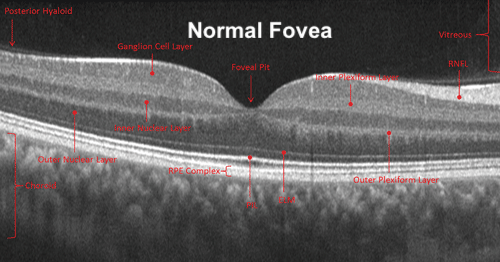
As you can see (left) , the top panel is a view of the patient's retina as observed directly from looking into the front of the eye. The lower panel is a an OCT image that shows the layers of the neural retina in cross section. OCT stands for Optical Coherence Tomography, and it is a way to use back-scattered light to see the layers of the retina. Obviously a very useful imaging system for your eye doctor. The green line on the top panel shows the location of the OCT scan. 

I have added the red arrow, pointing to the OCT image cross-section at the fovea from this patient with a fovea burn. This area is the part of the retina that you are reading this with now, your central, high-detailed, vision. That white stalk of burn damage should not be there. A normal undamaged human fovea does not have that burn feature, as seen in this normal retinal OCT scan below.

 OCT image of a normal fovea from "The ABCs of OCT" in the Review of Optometry.

So I hope that you were able to watch the Solar Eclipse of April 8th 2024 in a safe manner. My best advice for your vision health at any time is get an eye check-up at least every two years when younger and over 30 years of age it is best to get an eye exam once per year. If you have diabetes or heart disease then you want an eye exam every year regardless of your age. The reality is that most damage to your retina occurs without any sensation or pain, so many conditions affecting your retinas will be detected by your eye exam and catching retinal conditions early is important for possible treatment. Once photoreceptor cells have died, there is nothing currently that modern medicine can do to fix that.

Ken Mitton


March 26, 2024

How to Watch the Solar Eclipse Safely, from a Vision Scientist.

I wrote about this during the last eclipse in 2017, now its time to update for this April 2024. How can you watch the solar eclipse without harming your eyes? What is so scary about a solar eclipse? Are there some special rays of light that only occur during the eclipse that make the Sun dangerous to our retinas? Actually, the answer to the last question is, no. So why is it dangerous to look at the eclipse with the naked eye? Read on for the answers.

February 20, 2024

The Science Rant's Most Read Post of the last 12 months is from 2018: Hockey Pucks and Locks for Classroom Doors


By far, the most-read post in The Science Rant over the last several months into 2024, and over the entire existence of this blog, continues to be from 2018:

"Run, Hide, Fight: Is Your Kid's University Campus Unprepared for a Campus Shooter?"

This was a post I wrote during the moment when my university, Oakland University, decided to address the installation of door locks that could be activated from inside the classroom by professors and students during an active shooter situation. This post continues to be the most read over the last year and the last few months and I think interest renews every time we have another shooting on an American campus. 

While there are no guarantees for absolute safety when a killer has a gun, the inability to lock doors was sadly brought to the public's attention last year at Michigan State University. At that moment anyone who might have thought that students and faculty at Oakland University lobbying publically for interior classroom door locks was excessive learned that OU made a wise decision in 2018. The administration listened to its community and they made one essential step for trying to protect our community. 

The sad situation is that while most grade schools and high schools in this country have interior lockable classroom doors and active shooter practice drills for all staff and students, that is not the case when your children arrive at most colleges. 

So ask your college-attending kids this week if the doors of all their classrooms are lockable from the inside.

You can check out the popular 2018 post here and read about the famous Hockey Puck campaign of 2018: Run Hide Fight

February 16, 2024

COVID-19 Vaccine has performed well against recent variants so far this season.

 The CDC reports that the current updated COVID-19 vaccine has performed well against strains of the virus so far this Fall and Winter (2023/2024). That includes the JN.1 variant.

CDC Vaccine Performance Update


August 29, 2023

Show this to your Parents: Scientific Truth about WHY Your TUITION is so Expensive?

I may be a university professor now, but I was an undergraduate student in college in the 1980s. The education cost in 1980 was about $4,500 per student. Most States provided about 70% of that to the university and the remainder, called tuition, was the student's share of the cost. It was about $1,200 a year then, which paid for an entire year (September to April) of a full-time student course load. Not $1,200 per course, $1,200 total. To put that in perspective, we could get a full-time summer job, make $500 per month, and save our next year's tuition after 2-1/2 months of work. Then the rest of the Summer was money we could use for other things. So how do we get to $15,000 plus per year in 2023? Its is very simple when you compare the education cost and the tuition between the 80's and now. 

February 22, 2023

Rare Disease Day 2023 - the last day of February each year.

It has been 40 years since the Orphan Drug Act was passed by the United States Congress to incentivize the development of treatments for "orphan", meaning rare, diseases. In 2022 Congress also passed the Rare Diseases Act to amend the Public Health Service to form an Office for Rare Diseases within the National Institutes of Health. One of the research areas within my laboratory targets orphan inherited pediatric retinal diseases. Diseases rarer than Retinitis Pigmentosa (RP) which is itself considered rare. These conditions include FEVR (Familial Exudative Vitreo-Retinopathy), Norrie Disease, Persistent Fetal Vascular Syndrom, and Retinoschisis. The first three conditions cause incomplete development of the blood supply for the neural retina within our eyes, causing blindness. The latter condition results in a very delicate neural retina where the layers of the retina can separate and become filled with liquid. This condition also causes blindness. All of these orphan diseases affect infants and children of all ages. Our lab at Oakland University, in the Eye Research Institute, carries out research DNA-sequencing for Families with these conditions who present at Associated Retinal Consultants here in Michigan. Families are from all over the country and also outside of the United States. Funding is difficult to find for rare disease research, but we seek support from a few private foundations so that no Family pays for the research DNA sequencing that we do. OU science students and OUWB medical students take part and learn about applied human genetics.

In North America, the National Organization for Rare Disorders (NORD), is a partner with several similar regional organizations to facilitate awareness and support for rare diseases around the globe. While rare diseases may have fewer affected persons, there are many different rare diseases and together they impact over 300 million people around the world. Do you have a rare disease or know someone with a rare disease? Seeking information? Please visit the NORD website. Please also share this blog post to increase awareness. February 28th is Rare Disease Day in 2023. 

Sincerely

Ken Mitton


PS Thanks to the Carls Foundation and Pediatric Retinal Research Foundation of Michigan for making our lab's research DNA-sequencing for Families possible in 2023. 


December 16, 2022

Twitter under Musk has Suspended Core American Reporters from our Free Press, and this Scientist has Suspended Twitter by Quitting it.

 I have decided that my participation in Twitter is now simply helping Twitter under Musk operate as he promotes anti-democratic groups, and racist groups, and has now blocked important access of real American Journalists who make up our Free Press. 

So this day, December 15, 2022 is my personal day of infamy when I not only uninstalled the twitter app from my devices but I canceled my twitter account as long-term user of well over a decade. I now have a Mastodon server-based account at https://techhub.social/@kpmitton and am already enjoying the democracy and values of like-minded individuals. No ads, no crap, just people like me who want to make the world a better place, but on a platform were no billionaire crazy autocrat can interfere with our communications. 

Check out my previous post here on The Science Rant if you want to know how to get rolling in the Mastodon environment. Most of the journalists that I follow, and scientists, and entertainers have accounts in the Mastodon Fediverse too. I really like the Mastodon App and its functionality. No control forcing things into my feed that I do not follow, no ads. For my chosen Mastodon homebase, techhub.social, many of us who use this node donate a modest few dollars per month to our server manager's Patreon fund and we are ad-free and in control of our own worldwide communication and sharing. It is like supporting public radio. It belongs to us and Musk can simply go sit on it. Twitter will be filing for bankruptcy early in 2023. 

Looking forward to 2023. Stay safe out there. Get those vaccinations and take care of each other. Welcome to the Dolphin crowd. Dolphins work together, they even kill sharks who try to hurt them. Swim smart out there.

Ken Mitton

November 20, 2022

Ok, What is this Mastodon Social Networking Thing and How Do I Move In?

 Mastodon, how do I move in?

So, you are on Twitter and have used the platform for many years like I have. (I was @kpmitton on Twitter for 12 years) Now we have had to deal with conmen, conwomen, narcissistic ex-presidents, white supremacists, liars, Nazis, anti-democratic power mongers, bigots, racists, and Elon Musk banning real free speach. So we all would like a place where the servers are not owned by one company, or one billionaire, and where fake news and misinformation are not permitted. That is where Mastodon servers were born designed to take the best of the earliest forms of networking on the Internet when it was mostly UNIX-based, command-line computers and accounts. Think nodes, think neurons, think decentralized networks, yet think also about being able to follow and be followed by anyone with an account on any of many Mastodon servers. Still able to have followers as you could on Twitter but Elon Musk and Donald Trump have no say at all about the Network nor can they permit hate and lies with the excuse (used wrongly) of freedom of speech. This is how Mastodon works. Imagine following other people and posting your own short thoughts just like twitter but there are NO ads. Imagine that you get to pick and choose all that shows up in your feed. Twitter was like that for its first three years. Where can you find this wonderful twitter replacement. Where do you find it, and how do you join it? It's as easy or as hard as it was when we all joined Twitter. We may fumble around a for a few days until we get the hang of it, but here is how to get there and how it works. It is no more complicated than Twitter, but better moderated by its users. That would be you and me. It does not run on commercial advertising revenue and it is not governed by algorithms that companies can pay to control who and what you see in a 1984 senario. How? Read on.

I will tell you right now that the easiest way to start with Mastodon is to use the App on your iPhone, iPad, or Android device. You can make an account from those apps. You can also go to a joining website portal. Before making your account, know this. It is possible to have your own username. On Twitter, I am kpmitton and in the Mastodon universe, I am also kpmitton. There is no one collection of servers run by "Mastodon". You might find you can make accounts with the same user name on different servers in the network, but that would not serve you well because users on any server can follow you and be followed by you from any server you live at. 

Mastodon is really the communication protocol that people use to set up servers which are called "instances" or "Mastodon Instances". They are really similar to different people having their own websites on their own servers. For social interaction and communication, it is like having many Facebook servers and different people grouped on different ones. This is kind of true about the Facebook platform. Yet everyone can connect with each other in Facebook. You are oblivious to the fact that you and your best friend may have Facebook accounts that are residing on completely different servers. However, Facebook controls it all, they own rights to use your words and videos, and images as you store them there for free. They can also change the name of the game, and the rules of the game at any time and you have no control over it. If Facebook decided to start charging $10 a month for your Facebook account, they could, they are a private company, and fundamentally a business that exists to make a profit. Same for Twitter, Instagram, Snapchat, and WhatsApp.

In the Mastodon universe, you see and know what server your account resides at. It is like your server is a particular town or city and your username is also linked to that address. Mastodon users with accounts on other servers can find you by searching your user name (kpmitton for me), or they can directly find your account with your full address. My "town" server is called "TechHub.Social" and it was started by a guy named Nic. A programmer. 

BEFORE you make an account browse the servers, or instances, available. Servers have been set up in this new social network by persons with various interests, so you may find one that is for journalists, or technology persons like myself (there were no bioscience ones, but biotech is tech too). These servers can often be joined by anyone, even if you are not a techno geek you are welcome to join Techhub.social. Do not rush, servers are not going anywhere. Then pick one and make an account for yourself. Again, you can start from the phone apps for Mastodon (in the Apple Store, or Good Play) and they will let you pick your user name, register your email, and be associated with one of the many servers now set up around the globe. Even some companies and institutions and newspapers are setting up their own Instances (servers) using Mastodon's open-source code. Servers have been set up for different parts of the globe, different work interests, arts, humanities, social connections, disabilities, and different Human Communities. No Nazis though. Not permitted. 

If you want to use a website from your laptop, you can join Mastodon at  joinmastodon.org . Again, do not be confused by all the server instances. No matter which one you join, you will have access to the entire collaborative community. If you are a photographer or editor, you may want to join a server that was started with your community in mind. A good place to make contacts with others who have your immediate interests. (Currently, 11/20/2022, there is NO mastodon.org. That domain is reserved but not used. Use JoinMastodon.org for web browsers.)

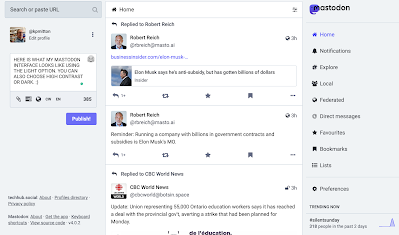
I chose to join TechHub.Social, an instance of Mastodon server set up by a fellow Canadian. (Turns out he is from Quebec. I was born in Quebec as well, but alas, I am an Anglophone Quebequois, not very French. But I bet we both like the Habs? Maybe we both like St. Viature Bagels in Montreal?) The Mastodon Apps are just like the Twitter apps in your hand. You see your posts (Toots I call them, elephants and mastodons toot, right?), and who you follow and who follows you. On my laptop here is the web version of my view right now using the "Light" colored option:


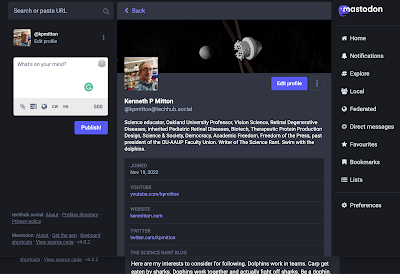
And here is my view when I select the "Dark" colors option:


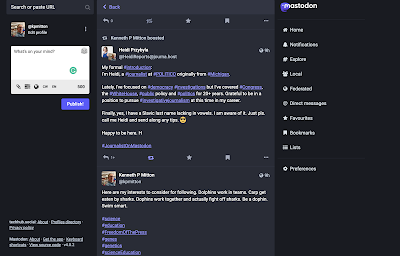
As you can see I have set up my profile picture from the Edit Profile option and added an Artemis-1 screen capture from NASA's mission tracker. I love NASA and space stuff :). I have started to add people that I follow, and some have started to follow me back. Here I can scroll down, like we do on Twitter, and read the posts in my personal feed from those I follow, or topics and #hashtags that I can set up to watch as well. Note that we can repost other posts too as in Twitter. In Mastodon, this is called boosting. 

In addition to seeing posts from those I set up to follow, I can click on Local and quickly see the recent posts from my local group or instance, that is the "TechHub.Social" server in the Mastodon federation. Like the Neural Retina that I study as a scientist, this federation is sort of like creating a whole field of vision from a network of photoreceptors. Vision is decentralized, in that if you lose photoreceptor "instances" in one part of your visual field, you still have the rest of your visual field. To take out your vision, you would have to neutralize the entire eye or take out the entire Internet to break Mastodon communication. Even if the Mastodon server I use was taken away, I would just move my account to a different server of which there will be thousands. All over the world. Servers are set up and communities of users chip in a few bucks to support having our servers up and running and we communicate and can share information. Follow and be followed. No Musks or Trumps or Nazis to cramp our Democracy. 

Find me on Mastodon. Look for kpmitton or kpmitton@techhub.social from inside your Mastodon. Think the bird is cute? So are Mastodons, as you can see from the info page of the techhub.social instance, set up by @Nicdex: See https://techhub.social/about


SUMMARY:

1) Use Mastodon App to set up your account, or go to the JoinMastodon.org website.

2) Browse around the different community interest servers (instances) available around the globe. Most let anyone join, but you may find one already started by persons in your career, hobby, or other interest. Some are just for social networking. It's kind of nice to belong to a specific server, yet be fully connected to the full network.

3) Make your account on the Mastodon instance (server) you choose. 


4) Just like Twitter, Instagram, and Snapchat, edit your profile and add some information. 

5) Send your friends your user name in Mastodon and invite them to join and find each other. 

6) I am @kpmitton@techhub.social (my account is based on the server with the domain name TechHub.Social, and it links and communicates in the greater Mastodon federation).


7) Enjoy no ads, and no longer have Elon Musk control what you see or follow. Also enjoy a place where it is not permitted to participate if you post misinformation or promote hate, antivaccine information, and other such harmful activity. LGBTQ community is welcome and attacks on persons or communities are not allowed to participate in the Mastodon network. 

8) Follow George Takei, just search for him. Your very first nice person.


Remember. You can be your own scientist. Knowledge is power.